Tuesday, June 1, 2010

Day 14 -- Off To Dalmacija


Charlotte:
Today we departed Mali Losinj, one of the northern islands, and headed south to Makarska (pronounced Mah-CAR-skuh). It is a small, beautiful city on the southern coast of Croatia, just down the road from Split. We spent almost all of the day traveling, but at least the drive was interesting. In order to leave Istria and enter Dalmatia, you have to pass through a tunnel that had to be at least 2 miles long. Those of us that play the "hold your breath until the other side" game didn't last too long. Once we were on the other side though...wow. I am so happy that this is where we will be spending the next 8 days of our trip. The Dalmatian roads we took along the coast offered some breathtaking views of the Adriatic.

After a few more hours of driving, we finally reached Makarska! We unloaded all of our luggage, waved goodbye to our faithful bus driver Franjo, and slowly checked into our apartments on the outskirts of the city. Once everyone was settled in, we regrouped at our new base of opperations, the restaurant Roma, and had a wonderful dinner. I already have a feeling we're going to enjoy this city.

Ben: We did spend the majority of today driving, but aside from the breathtaking views along the roads, we encountered one more thing that I believe is worth mentioning: the Croatian drivers. I've had some pretty close calls in my life while driving, but nothing compared to what I witnessed in Croatia. The coastal roads in Dalmatia are very narrow and very windy (and windy too - sometimes the wind coming off of the mountains is so strong they have to shut the roads down). There were countless cars and motorcycles that zoomed past our bus on these roads at just about the worst possible moments, narrowly avoiding oncoming traffic by mere inches. If only we had been filming, we probably could have sold the footage to Hollywood for some new high speed chase action movie. It was very intense.

Wednesday, May 26, 2010

Day 13 -- Veli Loshinj & Krk


Charlotte: This morning we checked out of the hotel in Mali Losinj, and headed to a Theraputical Facility in Veli Losinj (pronounced VEL-ee Low-Shing) that focused on skin and respiratory diseases where we met Renata Zugic the director of the facility. She explained to us that the main things that they treat there are skin diseases such as psoriasis and other skin conditions and asthma and other related respiratory diseases. Their goal is to treat with natural remedies and not use drugs to control these aliments their main therapies include:

Thalassotherapy - inhalation therapy and respiratory kinesitherapy that helps bronchial asthma.

Heliomarinotherapy - ultra violet light and sea water therapy that helps psoriasis.

Aromatherapy - using herbs and essential oils to heal aliments.

We then went to the Town Museum at Place Fritzy in the town of Meli Losinj. Mrs. Zrinjka Ettinger-Starcic lectured us on the discovery and restoration of a statue of Apoksiomen that was found in the sea off the coast of Mali Losinj.

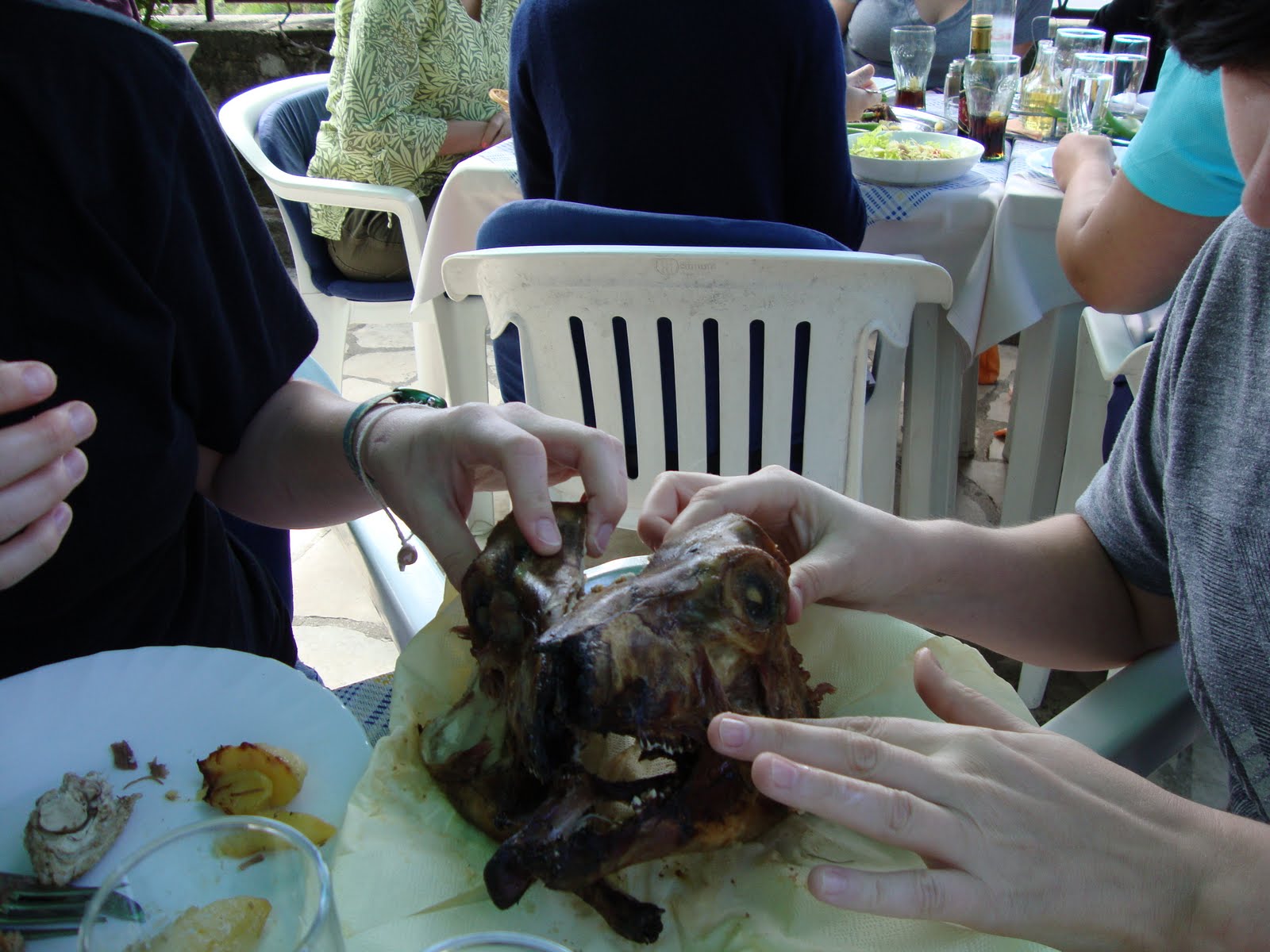
We then had lunch at Restaurant Leut in Belej, on the island of Cres. This was a very interesting lunch; we were served lamb cooked on a spit fire. It was an interesting new experience and some of our classmates were brave enough to try the delicacy of eating the brains, cheek, tong, eye ball and tail of the lamb. We then took a ferry to the island of Krk (pronounced KIRK), where we had free time for dinner and we proceeded to Njivice where we checked into our hotel.

Day 12-- Mali Losinj


Charlotte: Today we departed our mountain top hotel in Motovun, and headed for the coast! On our way to the coast, the Public Health students met with Helena Valcic, MD from the Medical Center in Labin. I can best describe this Medical Center with an American county health department and an emergency room all in one. This medical center included: primary care physicians, emergency department, OBGYN services, dentists, school heath, a dialysis center, a hospice, epidemiologists and public health inspectors for hotels and restaurants. We surprisingly got to tour every wing and saw several patients in the midst of their care. I did feel a little bit uncomfortable about seeing patients in the midst of their medical care, I felt like we were invading their privacy as comparison to the medical care privacy stands that we receive if we go to a doctor in the United Sates. While the public health students were at the Medical Center, the other students visited an old mine museum.

We then continued our journey by taking a ferry to the island of Cres (pronounced TRESS). Once on the island we stopped at a huge freshwater lake that is heavily protected by the government because it’s the only source of fresh water for the island. They have been very fortunate to have access to drinkable water on the island, many islands have to pipe their freshwater in from the mainland.

Drinkable water is a very important thing to think about when cities were designed. The five key aspects to water access include quality, quantity, proximity, reliability, and cost. All of these aspects must be accounted for when choosing where to live. Fortunately, Cres does have this lake to use as drinking water and the government and the people of Cres take great pride in keeping this water source free of pollutants. We then went to the historic town of Osor which is currently populated by only 68 people.

We then traveled to the city of Mali Losinj (pronounced MAL-ee Low-Shing) where we checked into our hotel. For dinner we went to a near by restaurant to try some local sea food. When we go out in a group we generally have a set menu that we are served and each course is usually some kind of a surprise. Our main course came out and it was whole fish was the heads and everything! I guess I looked a bit scared by the food and a server who spoke no English came over and slapped a fish down on my plate and started cleaning and preparing it for me to eat. The server then had to do the same for several other people on the trip. Once we got past the initial presentation of this food it was delicious.

Day 11 -- Pula


Charlotte: Today we visited the beautiful ocean city of Pula (pronounced Pool-LUH). Upon arrival we went straight to the coliseum, which is the second most intact coliseum in the world taking second to the coliseum in Rome, Italy. The architecture was amazing and to see it almost completely intact over thousands of years was unbelievable. We then went on a walking tour of Pula where we observed other beautiful buildings and arches. On completion of our walking tour we went to a lecture held by the Faculty of Humanities and Social Sciences at the University of Pula, on tourism. We learned that Croatia has many sites on the World Heritage list under UNESCO Protection a few of these sites include: the city of Dubrovnik, Plitvice Lakes National Park, the Cathedral of St. James in Sibenik, and Diocleation’s Place in Split just to name a few. Their main tourists population is made up of people from Germany 22.7%, Slovenia 11.2%, Italy 10.2%, Austria 8.9%, Czech 8%, Polish 5.4%, Dutch 4.8%, and Slovakia 4.0%. Their main tourist months are June through August and their main tourist locations are located on the Dalmatian coast. At the end of this informational lecture the University of Pula presented each and every one of us with a welcome gift, a leather bound, full size planner and journal, a pen and an informational packet on tourism and the University of Pula.

Our professors like to go to new places every year they do this trip and this year we were the gunnie pigs for probably the most unique experience ever! We went to Vodnjan, where we went to see mummies of the Saints! I truly thought this was a hoax and that it would be some tourist trap on the side of the road but it was actually at the local Catholic Church in Vodnjan. We took a tour of behind the alter, where the mummies are kept. We saw 4 whole mummies and body parts of other saints. This experience was truly eerie and one of my most memorable experiences of this trip. We were told the stories about why each of the 4 mummies was a saint and what made them famous, but it was really interesting to find out that they were not mummified. Their bodies were dug up from the grave and they their bodies were fully in tacked, two of the bodies even had elasticity left in their mummified skin. One of the nuns who was a saint had, an MRI six months ago and it was determined that her internal organs are still fully intact and that she is still giving on an energy. It is also said that she heals people with health aliments who visits. We were told of stories when a blind woman miraculously regained her vision by being there and praying and couples who were having difficulty getting pregnant have said that they were able to get pregnant after going to this site and praying to this saint. Maybe these events are miracles or merely hoaxes but it was defiantly and experience of a life time no matter what higher power you believe in!

After our mummy experience we went on the hunt for vampires! Well kind of… There was a legend of a vampire cursing a near by city for decades and we went to the location of the grave yard where he had been buried and explored. This stop on our trip was a bit disappointing. We could not see his actual grave because they keep building up the grave yard level after level when they get full and his level was near the bottom, so there was nothing really to see except for some really cheesy, Vampire CafĂ© Bar signs. After leaving we drove on a very scary, curvy road out to a country farm in the mountains where we had a very traditional dinner that was 7 courses! The food was unbelievable but the food just kept coming!

Day 10 -- Porec & Rovinj


Charlotte: This morning we departed Motovun, and visited the Euphrasian Basilica in Porec (pronounced Pour-eck) where we also met our tour guide for the next few days, Aleksandra Paic. We toured the Basilica and made the long trek to the top of the bell tower to get our first view of the coast. After a mini tour of the city we were given free time to explore. We had lunch in a fjord off of the Adriatic where we had the opportunity to try any sea food items we wanted.

After lunch we went to the city of Rovinj (pronounced Row-veen) where we visited another Catholic Church. We had free time in Rovinj and then we stopped at an abandoned castle outside of the city on the way back to the hotel. The castle ruins were really cool! The castle was abandoned many centuries ago due to plague. It was situated on the top of a mountain and the view was gorgeous! After we explored the ruins we traveled back to Montovun where we had dinner on our own.

Ben: I guess this is as good of a time as any to continue my discussion of pharmacy. In my previous post, I talked about the wide scale, macro view of pharmacy as it is in Croatia. Today I’m going to bring the scope in to a more micro, functional view of how the pharmacy operates. Again, I’m going to do my best to compare it to the American system, and then try to show you how all of this is relevant to public health.

We’ll start today where the prescription normally starts: the doctor’s office. Croatia employs socialized healthcare (about which I’ve heard a wide range of opinions, but I’ll leave that for someone else to touch on), so when you get sick, you go to whatever doctor you wish to see, and in most circumstances, they will write you a prescription. The physical prescription basically requires all of the same elements that are required on a prescription in America: patient’s name, date of birth, medication, dosage, frequency, amount, and refills allowed (so far so good). The piece of paper that each prescription is written on is also color coded to correspond to how the medication will be covered by insurance: Blue = free medication (completely covered), red = partially covered (copayment required), and a 3rd (yellow I think) that the insurance doesn’t cover at all (these are special case medications that are usually very expensive).


Once a patient has their prescription, they take it to a pharmacy to be filled, just like America. However, that’s about where the similarities stop (and some of the health issues begin). Before I dissect the Croatian pharmacy, I want to point out that they are somewhat behind America in terms of technology in the pharmacy. A few decades behind, actually. According to what
Mr. Pharm. Spec. Maja Bernasek told me in our meeting, all labels on prescriptions are written in by hand. No computer generated labels, just pen and sticky paper. This is not really a problem, unless the pharmacist has poor handwriting (such as me). The problem is that there is no continuous electronic record of medications that the patient is taking, and there is no medication cross checking run through a computer. This can potentially lead to many serious (and deadly) drug interactions, just because the pharmacists do not have an electronic record of what medications each patient is taking or is allergic to.

When MPS Bernasek told me this, my jaw hit the floor. I cannot imagine working as a pharmacist and not having these tools at my disposal. I would love to see some statistics on the number of deaths in Croatia due to drug interactions, but as of now I have been unable to find any (in America, drug interactions kill thousands of people, injure millions, and cost the healthcare industry billions of dollars each year). The good news is that pharmacies are slowly trying to incorporate these computer systems into place (unfortunately, cost is a preventative issue).


Aside from an obvious lack of technology inside the pharmacy, the process runs about the same as it does in America: a patient drops the prescription off, the pharmacist fills it and then checks it, and then the pharmacist dispenses the medication to the patient. When they hand the medication over to the patient, the pharmacist counsels them on any pertinent information relative to the prescription. At this point, any information the pharmacist passes along to the patient comes either from memory, or from any medical text they might have on hand. Again, this is due to a lack of technology. In America, practically every pharmacy has access to internet based medical data, as well as computer-printed medication labels that automatically list any pertinent information the pharmacist should inform the patient about. Hopefully this will change with time.


There was one very important item that I particularly like about pharmacies in Croatia: patient privacy rights. In America, we have HIPAA (The Health Information Portability and Accountability Act of 1996), which, if violated, offenders can face criminal and civil charges. In Croatia, they have some very similar laws that require pharmacists to maintain discretion with sensitive health-related information, and violations of this are also punishable by law. This is definitely a step in the right direction, as it helps bolster the defense against disease-based discrimination.


So, to wrap this up for today, Croatia has a functional healthcare system that allows for any citizen that is in need of medical attention to be taken care of. Although the pharmacies may be lacking in cutting edge technology, the pharmacists themselves work very hard to ensure that the proper care is given to each and every one of their patients. They are a crucial cog in the healthcare machine of Croatia.

Day 9 -- Leave Eastern Slavonia for Istrian Peninsula


Colin: No one is sorry to be leaving Osijek for the Adriatic Coastal portion of Croatia today. Six days of very cold and wet weather are more than enough for anyone. We are cold, and tired, and are getting on each others nerves (and getting each other sick). But as we drove West towards the coast, the weather warmed, the sky cleared up, and at a rest stop the mood started to brighten as well. People started to laugh, kick a soccer ball back and forth near the bus and generally appreciate the change. We have left Eastern Croatia behind and have moved onto the second part of the trip.

Istria (pronounced IST-ree-uh) is a peninsula that sticks out into the Adriatic Sea and contains the oldest Roman ruins in Croatia. The climate is one more like the Greek islands and less like that of Central Europe. The local diet will be one more based on fish, olive oil, and figs, as opposed to the Central European-influenced meat (especially pork) and potatoes that we have been eating for the past nine days. However, we had one more meal of it as we dined for lunch on venison and dumplings at a restaurant in the small town of Fuzine, and afterwards we took a side trip to the cave that was discovered in the 1960’s but had been sealed for 100’s of thousands of years.

When we first saw the sea a great cheer went up on the bus. Our bus driver is named Franjo (pronounced Fran-YO) and we have become very impressed with his skill as he maneuvers the “Purple Horse” through a variety of locations with much skill and acumen. We have started to refer to ourselves as the “Purple Horse Gang” and have become one big happy, dysfunctional family. [Ben - the "Purple Horse" (of course, of course) refers to our gigantic purple bus.]

As impressed as we are with Franjo’s driving skills, we are less impressed with the skills of other Croatian drivers. Motor Vehicle Crash deaths and injuries (including those to pedestrians and bicyclists committed by automobiles) are the leading source of Emergency Room visits in Croatia. Many of the safety standards that we take for granted in the U.S. regarding mandatory safety equipment and speed zone enforcement either do not exist in Croatia or are not enforced. We are glad to be in the capable hands of our expert bus driver.

Our destination for the evening is the hilltop town of Motovun (pronounced Mow-tow-voon), where a group as large as ours cannot even be taken all the way to the top because the bus cannot climb that high, but must walk the last 500m up the narrow cobblestone streets to the Hotel Kastel. The town has a spectacular view of the valley below and many folks celebrated late into the night and were very happy with our new surroundings.

Day 8 -- Day trip to Vukovar


Colin: I am not sure if the weather could have more perfectly matched the mood and subject matter of the impact of the “Homeland War” on the City of Vukovar. We were cold and wet and trying our best not to get sick. We had to stop to buy vitamins and warmer clothes in our best attempt to ward off any further sickness. And, while all of this was going on, we were being told about the 1991 siege of the city where 40,000 inhabitants held off the Serbian dominated Yugoslav army and its associated Serb militias for better than 3-months. We met the doctor who ran the hospital during the siege, Dr. Vesna Bosanac. She is a Croatian National Hero and a living treasure, who explained what she and her staff did to help the population during this time of crisis from the underground bunkers below the destroyed hospital.

After the siege ended, the entire population of the town was forcibly relocated or killed. Some were sent to prison camps in Serbia, while some were allowed to return to Croatian controlled territory. Others, however, were taken to places like Ovcara where they were shot and dumped into mass graves. Many of these graves were not discovered until after the Dayton Accords were signed in 1998 and Vukovar returned to Croatian control.

War not only has an impact on the physical health of populations, but also psychological repercussions. Refugees not only have the trauma of being subjected to the war, but also have the long-term impact of being displaced from familiar surroundings and from ones livelihood. Vukovar is a living example of the resilience of a community that is able to recover from such atrocities.